
Proposal (2023/2024)
This Master Thesis extends my earlier research on the Glasgow housing crisis, which initially focused on social, cultural, and political causes of health inequities in housing. While that work demonstrated how short-term, large-scale building programmes often prioritised quantity over quality, leaving many homes below habitable standards, the present research examines the problem from a technological perspective. It asks whether the building methods and regulations applied since 2000 are adequate to ensure healthy, durable, and sustainable housing, or whether they risk repeating the failures of the past.
The study investigates selected post-2000 housing developments in Glasgow through detailed building surveys and photographic documentation, supported by analysis of planning applications and construction records. The research is guided by the following questions:
- What defects or weaknesses can already be identified in relatively recent housing stock?
- How do these issues affect building lifespan, occupant health, and overall housing resilience?
- Do current Scottish building regulations sufficiently safeguard against these problems, particularly when compared with European standards?
- What technological strategies could be introduced to mitigate risks and extend the longevity of housing stock?
The methodology is exploratory, correlational, and comparative: it documents physical evidence of defects, links causes to long-term consequences, and contrasts national practices with international benchmarks. By combining this with insights from residents’ experiences, the research highlights both visible and hidden issues in contemporary housing.
The ultimate aim is to develop a set of guidelines and interventions—ranging from improved detailing and insulation to more robust regulatory standards—that can strengthen the resilience of post-2000 housing. Placed alongside my Design Thesis on pre-2000 housing, this project forms part of a continuous inquiry into Glasgow’s housing history: analysing the past through repair strategies, the present through critical assessment of recent construction, and the future through proposals for healthier, longer-lasting, and more sustainable homes.
The final thesis presents the outcomes of that inquiry, leading into a focused investigation on wall technologies, embodied carbon, and building longevity, which forms the basis of the following abstract.
Conference Poster
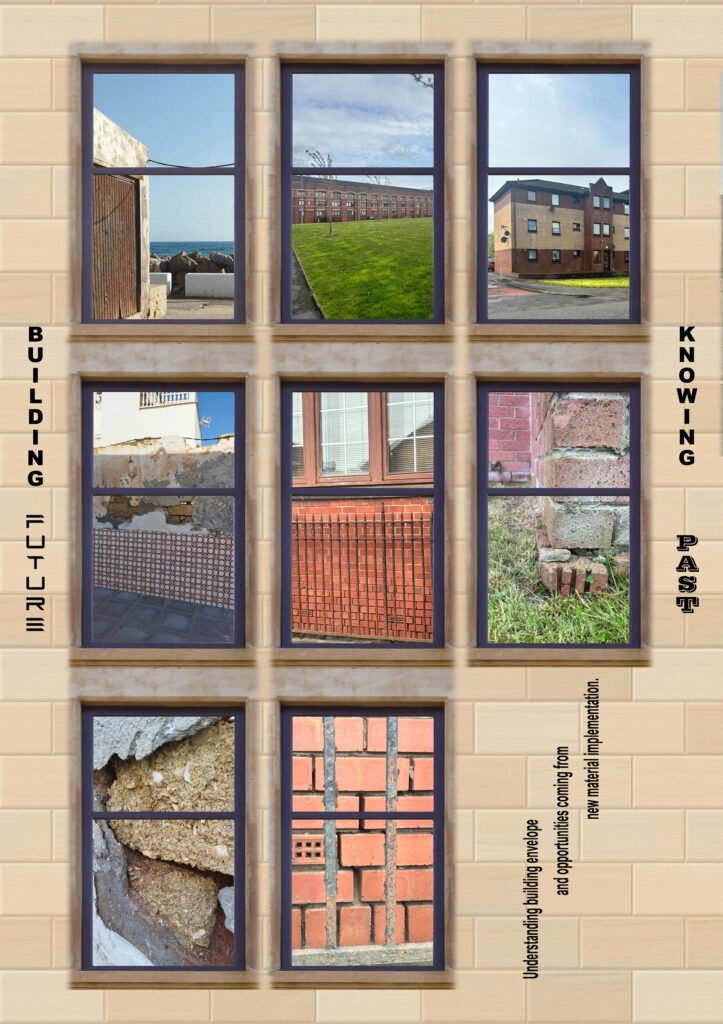
Conference Paper
Abstract
This dissertation investigates the differences between different types of walls, considering the amounts of embodied carbon delivered by each technology, as well as comparing the amount of operational energy needed.
It is discussing if the use of the definition of self-built in terms of timber frame wall is appropriate and suggest technology simple enough to be constructed by unskilled community members.
The findings highlight differences in longevity between timber frame construction and solid masonry, here considered as biofiber-based hempcrete. While timber frame is widely used in new-build housing, it has significant limitations such as short life span and vulnerability to moisture.
In contrast hempcrete offers at least 3 times longer lifespan due to its technological simplicity, solidity and reduced number of materials utilised in wall construction that can fail.
These studies contribute to the field of architecture by showing positive aspects of bio-based materials and their positive impact on occupants’ health and the environment.
According to the Vitruvius’s principle “firmitas, utilitas et venustas” – durability, convenience, and beauty it takes reader for a journey to explore the possibilities and threats connected to implementation of different wall technologies. It is not only showing deeply rooted connection to the architecture but it also makes us question whether the quality of today’s dwellings can be called architecture when we know that so many of them are harmful to human beings.